



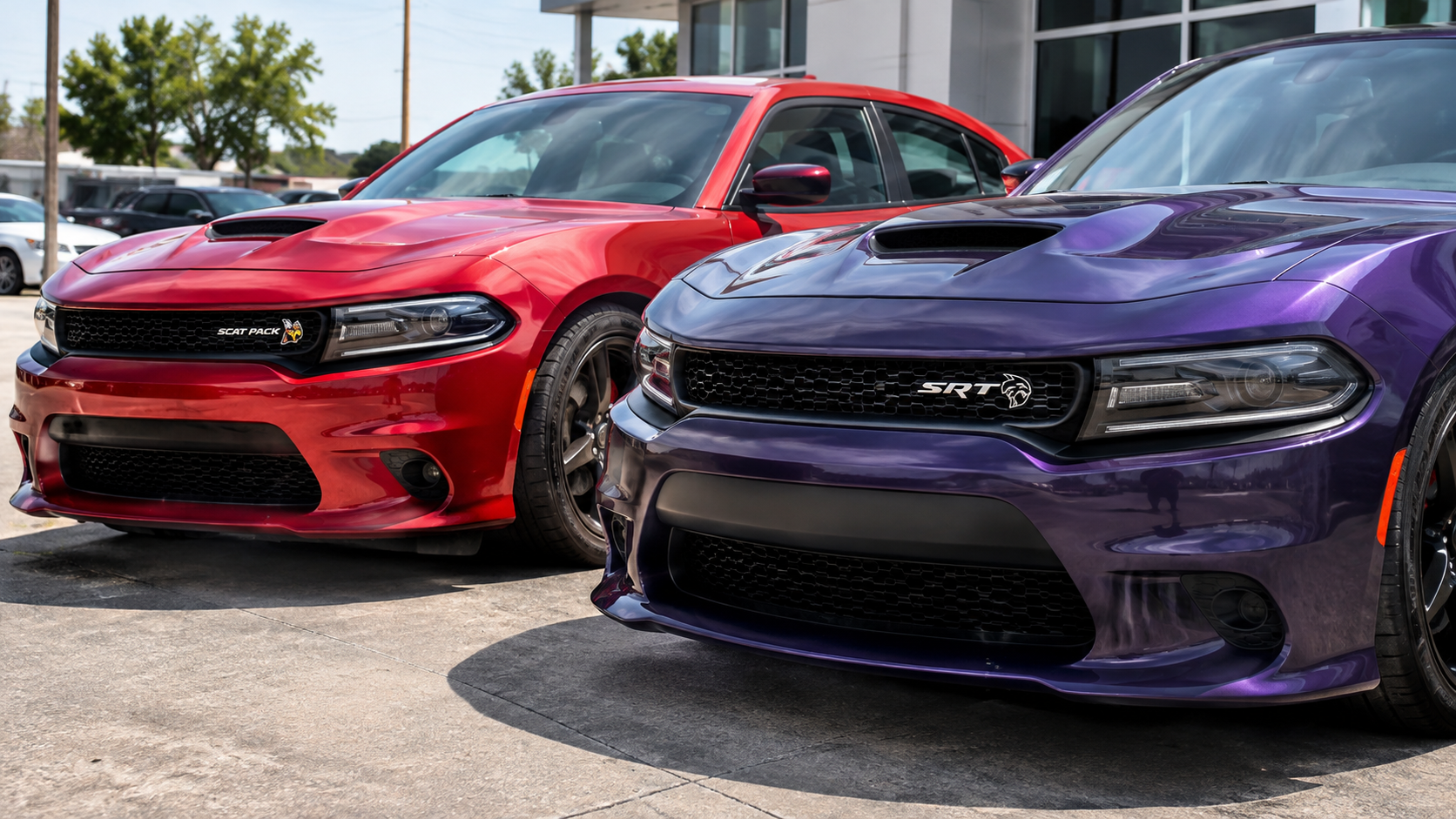
Scat Pack and Hellcat Chargers may look similar in photos. However, their names point to different engines and model years. That distinction matters when you are sorting listings and deciding which Charger deserves a closer look. The Scat Pack name has continued into newer Chargers, while Hellcat identifies an earlier supercharged V8 Charger. Therefore, read the model year and engine description alongside the badge before selecting a vehicle.
What the Dodge Charger Scat Pack Name Identifies
Scat Pack is a Dodge badge for certain higher-output muscle cars, not a permanent description of one engine. On the 2023 Charger, Scat Pack identified a 6.4-liter 392 HEMI V8 with natural aspiration. Natural aspiration means the engine draws in air without a turbocharger or supercharger. That setup separates the older Scat Pack from the supercharged Hellcat. However, it does not describe every Charger carrying a Scat Pack badge today.
Why do used Charger listings mention 392 alongside Scat Pack? The number refers to the engine's displacement in cubic inches. Therefore, a 2023 Charger Scat Pack listing may identify that engine as a 392 HEMI. The badge provides a starting point, but the model year confirms which generation you are examining.
Additionally, newer Chargers retain Scat Pack as a name while using different sources of power. For this reason, do not assume a Scat Pack listing identifies a V8 without checking its year. A 2026 gas-powered Charger Scat Pack has a twin-turbocharged inline-six instead. Dodge also offers an electric Charger Daytona Scat Pack, which has no gasoline engine. The badge alone cannot tell you which drivetrain sits beneath the bodywork.
What Makes a Charger Hellcat Different
Hellcat identifies the supercharged 6.2-liter HEMI V8 associated with previous-generation Charger SRT models. A supercharger forces additional air into an engine using a mechanically driven compressor. With more air available for combustion, the engine can generate greater output. Therefore, the distinction from an older naturally aspirated Scat Pack goes deeper than exterior badges.
Is an SRT Charger automatically a Hellcat? No. SRT stands for Street and Racing Technology, and that label has appeared on different Dodge configurations. Hellcat identifies a particular supercharged engine family, while Redeye identifies a higher-output Hellcat variant. These names serve different roles when you decode a listing.
Three labels are worth separating before you compare older Chargers:
- SRT: This designation refers to Dodge's Street and Racing Technology division and certain vehicle variants. By itself, SRT does not confirm that a listed Charger has a Hellcat engine.
- Hellcat: On previous-generation Chargers, this name identifies a supercharged 6.2-liter HEMI V8 configuration. Confirm the model year and factory trim before relying on an advertisement's badge description.
- Redeye: This name distinguishes a higher-output version of the Hellcat engine family. Therefore, a Redeye listing needs its own factory equipment verification instead of relying on exterior appearance.
Dodge also used distinctive fender and grille details on these cars. Still, badges and decorative parts can change after a vehicle leaves the factory. Consequently, the original equipment record provides stronger evidence than photographs alone.
Scat Pack and Hellcat Across Charger Model Years
For this reason, the model year is the fastest way to avoid confusing two Charger generations. In 2023, a Charger Scat Pack used the naturally aspirated 392 HEMI V8. By contrast, a Charger SRT Hellcat used a supercharged 6.2-liter HEMI V8. Those names represented separate factory configurations within that generation.
For 2026, Dodge lists a gas-powered Charger Scat Pack with a 3.0-liter twin-turbocharged SIXPACK High-Output inline-six. Its two turbochargers compress incoming air using exhaust energy, unlike a mechanically driven Hellcat supercharger. In addition, Dodge lists the Charger R/T with a Standard-Output version of the SIXPACK engine. The Scat Pack and R/T therefore use related engine architecture but different factory output configurations.
The 2026 Charger Daytona Scat Pack takes another route. It uses electric motors and a high-voltage battery instead of a gasoline engine. Consequently, the Daytona designation is essential when identifying that version of the Charger. A gasoline Scat Pack and an electric Daytona Scat Pack are not the same drivetrain.
Does Dodge list a 2026 Charger Hellcat? No. Dodge's published 2026 Charger lineup identifies gas-powered R/T and Scat Pack models, plus the electric Daytona Scat Pack. Therefore, a Charger Hellcat advertisement should prompt a check of the year and vehicle records. The familiar name alone does not identify a new 2026 Charger offering.
How Charger Badges Relate to Engine and Equipment
Additionally, Dodge names can identify a trim, an engine family, or a specific version within a trim. Optional equipment can differ between otherwise similar Chargers. For this reason, treat each name as a clue, not a complete description of the vehicle.
These common Charger labels illustrate what to check:
- R/T: On 2026 Chargers, R/T identifies the gas-powered SIXPACK Standard-Output configuration. Older R/T Chargers have different engines, so always confirm the model year.
- Scat Pack: This designation identifies a higher-output Charger variant. Check whether a listing refers to an older 392 HEMI, a newer SIXPACK, or an electric Daytona.
- SRT Hellcat: On previous-generation Charger listings, this name points to the supercharged Hellcat V8. However, you should still verify the original factory trim and engine.
- Redeye and Daytona: Redeye identifies a Hellcat variant, while Daytona identifies an electric Charger in the current lineup. These labels should not be treated as interchangeable equipment packages.
Still, a widebody appearance or a distinctive emblem can draw your attention. Nevertheless, appearance does not establish what the factory installed. Wheels, badges, and exterior trim may differ through optional packages or later modifications. Therefore, ask for the original window sticker or factory equipment details when available.
How to Verify a Dodge Charger Listing Before Shopping
A clear listing should connect the Charger name to a specific model year, engine, and factory configuration. Before scheduling a visit, compare that information with the vehicle's identification records. A VIN identifies an individual vehicle and can support a review of factory details. However, a VIN decoder alone may not list every option or later modification.
Use these checks when narrowing Charger listings:
- Confirm the model year: Separate older V8 Chargers from newer SIXPACK and electric versions before comparing the same badge name. This prevents confusion between distinct generations.
- Check the listed engine: Look for 392 HEMI, supercharged 6.2-liter HEMI, SIXPACK, or an electric drivetrain. Then verify that description against factory information.
- Review the original trim: Request a window sticker or factory equipment record when available. This gives more reliable detail than an advertisement title alone.
- Inspect equipment descriptions: Check drivetrain, body style, brake equipment, and optional packages against the exact vehicle. Do not assume every car sharing a badge has identical equipment.
- Ask about modifications: On a used Charger, confirm whether previous owners changed engine components, exterior badges, or other parts. Original factory information and the vehicle's present state may differ.
Therefore, these steps let you compare what a listing promises with what the vehicle contains. They also make a conversation with a dealership more specific. Ask which year, engine, and factory trim a Charger has. The name alone is not enough.
At Ross Downing CDJR, you can use these distinctions to narrow your Charger options before visiting. When you are ready to examine available models, browse the new vehicle inventory and confirm each listing's current details. Availability varies, and a new Charger listing should not be mistaken for a previous-generation Hellcat.